Platform


Services




Compliance Tools


20 Sep 2026
Supplier Verification UAE: The Input VAT Rule That Starts 1 October 2026
By DocuBay Editorial Team·Reviewed by Asad Jaffery, Founder, DocuBay
There is no fine attached to this one, and that is exactly what makes it expensive. From 1 October 2026, Federal Tax Authority Decision No. 13 of 2026 requires every VAT-registered business in the UAE to run documented checks on its suppliers before deducting input tax. Miss them on a supply connected to tax evasion and the Authority can simply refuse the deduction, so the cost is the VAT you expected to reclaim rather than a capped penalty.
We process over 500 government applications a month at DocuBay, so we see which rule changes quietly reorganise a finance team’s week. This is one of them, and it arrives the day after the corporate tax return deadline.
Where the rule comes from
Federal Decree-Law No. 16 of 2025 inserted Article 54(bis) into the VAT Law, letting the Authority deny input tax recovery where a supply forms part of a chain connected to tax evasion and the recipient knew, or should reasonably have known, about it. That created the exposure without saying how to avoid it. Decision 13, issued on 22 July 2026, fills the gap: it sets out the measures required before deduction, and it takes effect on 1 October 2026.
This is wider than any AML rule
The checks look like customer due diligence, and anyone already running screening will recognise them. The obligation is not the same. Anti-money laundering due diligence under Federal Decree-Law 20 of 2018 binds financial institutions, DNFBPs and virtual asset service providers, and it is aimed at customers. This decision binds a taxable person, defined in Article 1 as anyone registered or obliged to register for tax. No carve-out by size, sector or risk. A trading company that has never filed a suspicious transaction report and has never heard of a DNFBP is squarely inside it, because it claims input tax.
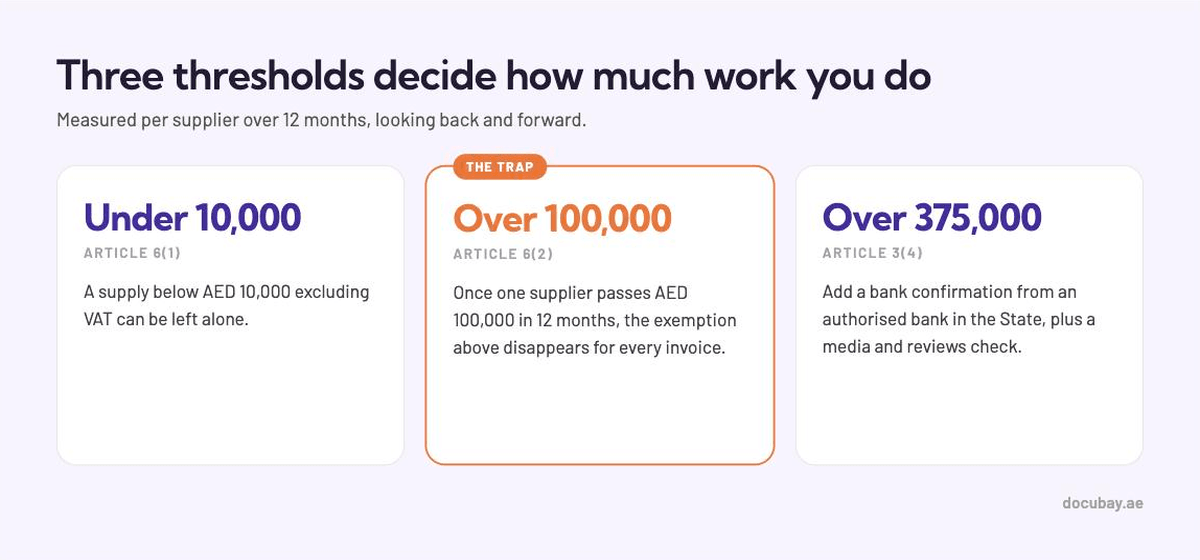
The three thresholds
| Threshold | What it does | Source |
|---|---|---|
| Under AED 10,000 | Where the consideration for a supply, excluding VAT, is less than AED 10,000, the measures may be disregarded | Article 6(1) |
| Over AED 100,000 | Where total supplies from that supplier exceed AED 100,000 over the previous 12 months, or are expected to over the next 12, the exception above does not apply at all | Article 6(2) |
| Over AED 375,000 | Written confirmation from an authorised bank in the State that the supplier holds an account, plus a review of publicly available reviews and media coverage | Article 3(4) |
The trap is the middle row. A supplier used for small routine purchases looks exempt invoice by invoice, and stops being exempt the moment the rolling twelve-month total passes AED 100,000. Because the test also covers what you expect over the next twelve months, a supplier you have just signed an annual arrangement with is in scope from the first order. Anyone judging supplier by supplier off a single purchase order will get this wrong.
What you check on the supplier
For an individual, obtain valid proof of identity and meet them, in person or virtually, before the supply. That meeting requirement applies to natural persons only, which several early summaries of the decision got wrong by applying it across the board. For a company, verify incorporation through official databases or the certificate, then verify the identity of the director, agent or employee authorised to represent them.
Both routes then converge on premises and risk. Verify an actual place of business exists, by electronic means or a field visit, and that it fits the activity carried on there. Then check three risk indicators: address changed more than twice in twelve months, key employees changed more than twice in twelve months, or transactions disproportionate to the size and history of the business. Where one applies, the decision does not block the deal. It requires a clear and justified explanation on file, produced to the Authority on request.
What you check on each supply
Article 4 is the half most coverage skips, and it applies to every taxable supply rather than once per supplier. The supplier’s involvement must rest on genuine commercial reasons. Payment is to be made electronically, and cash needs a documented commercial reason. A third party in the payment chain, or payment to an account outside the supplier’s country of incorporation, each need a reasonable explanation on record. Prices and margins must not sit far from market without a clear reason, the goods must fall inside the supplier’s licensed activity, and you must verify the origin of goods and the supplier’s right to sell them.
The policy you cannot backdate
Article 5 turns the checks into a process: verify each supplier on first dealing and again where they have not been verified in the previous twelve months, verify each supply, document the steps, and retain the records. The fourth requirement is the one to act on this month. You must hold a documented policy naming who implements, reviews and supervises the checks, with their powers set out clearly, kept where the records are kept. Under a rule where the defence is evidence that you looked, an undocumented check is worth the same as no check at all.
What to do before 1 October
Work by exposure, not alphabetically. Pull twelve months of purchase data and rank suppliers by value. Anything above AED 375,000, actual or expected, needs the bank confirmation and the media review, and the bank confirmation depends on the supplier acting, so send those requests first. Anything above AED 100,000 needs the full Article 3 file regardless of invoice size. Then write the policy, because it is the shortest item and the only one you cannot produce later with any credibility.
The checks themselves are familiar work in an unfamiliar place. Identity, premises, bank confirmation and media review are the same operations behind KYC and AML screening, which is why businesses already screening have a head start even though the legal basis differs. What is new is that the output must survive a tax audit and reconcile with the numbers in your VAT return filing. For how this sits against the rest of the year, see the UAE compliance deadlines businesses miss, and VAT registration in the UAE for who counts as a taxable person.
Need help with your next step?
Speak with a DocuBay specialist or explore the platform to see how we can help streamline your compliance and business workflows.
Featured
Articles

The Cheapest UAE Free Zones in 2026, With Verified Prices
Ten zones publish starting prices under AED 10,000 a year, from AED 3,500. What the low price includes and what it hides.
Read the free zone price guide
WPS Rules Changed in June 2026: The New Salary Deadline Every UAE Employer Must Meet
Since 1 June 2026 wages are due on the 1st and the 15-day grace period is gone. The enforcement clock and the AED 1,000 per worker fine.
Read the WPS deadline guide
E-Invoicing in the UAE: A Practical Guide for SME Owners
E-invoicing in the UAE is more than a technical change. What the 2027 mandate means for SMEs and how to prepare.
Read the e-invoicing guide
Take your Business
to the Next Level

Connect with us to discover,
How DocuBay can streamline your business operations in UAE.
Or take DocuBay with you: