
Bayswater Tower, Business Bay, Dubai

+971 4 5768705

Why DocuBay

Services

License & Compliance Management


Workforce & Employment

Permits & Approvals

Insurance & Risk Management

Legal Services

Audit, Tax & Accounting

Company Formation


AML Compliance & Risk Management
UAE AML & goAML Compliance Managed Through One Platform
DocuBay helps businesses manage AML and goAML compliance through a single platform, enabling customer due diligence, risk screening, and regulatory reporting while connecting you with trusted service providers when needed.
Run due diligence and screening in DocuBay, and route specialist steps to vetted providers when required.




500+
Applications Processed/Month



25+
Skilled Team Experts



The Compliance Risk Businesses Cannot Ignore
UAE AML requirements are stricter than ever, and regulated businesses are expected to keep clear records, verify customers, monitor activity, and report suspicions through the goAML system. These obligations apply across sectors such as real estate, corporate services, accounting, and precious metals and stones, based on your license and supervisory authority.
AML compliance isn't a one-time task. It requires ongoing due diligence (CDD/EDD), sanctions and PEP screening, monitoring, and timely reporting when red flags appear. When these steps are handled through disconnected tools or manual processes, gaps become more likely, leading to regulatory scrutiny, operational disruption, and reputational risk.
A Structured Approach to AML Compliance
Rather than treating AML compliance as a one-time task, DocuBay helps organizations build sustainable compliance frameworks that bring due diligence, monitoring, and reporting into a single structured workflow.
Our approach focuses on three core pillars that help businesses manage AML obligations more effectively:

Risk Awareness
Understanding financial exposure and transaction patterns through structured customer due diligence, risk assessments, and screening processes.
Regulatory Alignment
Ensuring policies, procedures, and reporting workflows are aligned with UAE AML requirements and goAML reporting expectations.
Operational Implementation
Integrating AML compliance processes into everyday business operations through automated workflows, centralized documentation, and connected service providers.
By combining these elements within one platform, businesses gain greater visibility into compliance activities while reducing operational complexity.
AML & goAML Compliance Capabilities on DocuBay
DocuBay provides a structured set of tools and services designed to help businesses manage AML obligations efficiently.

goAML Registration
Support for two-stage setup: SACM access registration and goAML entity registration, including required user roles and access configuration.

AML Risk Assessment
Assess exposure to financial crime risks based on business activity, customer profiles, delivery channels, and transaction patterns.

AML Policy Development
Establish internal AML policies and procedures that define risk controls, monitoring expectations, escalation steps, and reporting workflows.

AML Training
Equip teams to recognize suspicious activity, follow internal controls, and respond consistently when escalations occur.

Customer Due Diligence (CDD & EDD)
Verify customer identities, apply risk-based due diligence, and perform enhanced due diligence for higher-risk customers.

Sanctions & PEP Screening
Screen customers against sanctions and PEP datasets to identify compliance risks and trigger appropriate escalation steps.

goAML Reporting (STR/SAR + FIU Follow-ups)
Prepare and submit STR/SAR reports through goAML when suspicion arises, and support FIU follow-ups through structured submissions such as AIF/AIFT when requested.


Simplify AML Compliance with DocuBay
A structured rollout that starts with risk assessment and ends with ongoing compliance monitoring.
- 1
Start Your goAML Compliance Setup
Share your business activity and licensing details so the right compliance scope can be applied.
- 2
Risk Assessment (Risk Awareness)
Assess your exposure based on customers, transaction types, delivery channels, and risk level.
- 3
AML Policy & Framework Creation
Generate an AML policy and internal framework aligned with your business risk profile.
- 4
Tools & Risk Controls Configuration
Configure due diligence workflows, screening tools, and escalation rules inside DocuBay based on your policy.
- 5
Compliance Monitoring Enabled
Activate ongoing monitoring so checks, escalations, and documentation stay consistent and reporting-ready.
- 6
MLRO Assignment (Optional)
Assign your internal MLRO or appoint an MLRO through DocuBay, based on your operating model.
The DocuBay Advantage
Business owners need a clear view of their compliance, renewals, and regulatory obligations. DocuBay brings structure, visibility, and control to the day-to-day management of business-critical requirements.

Full Visibility
See what is due, what is in progress, and what requires attention across your business, so compliance is easier to monitor and manage.

Better Compliance Control
Stay on top of deadlines, renewals, and regulatory requirements with a system designed to keep key obligations visible, organised, and on track.

Smarter Renewals
Manage renewals more efficiently with timely reminders, application tracking, and easier access to the actions required to keep your business moving.

Informed Decisions
Get a clearer view of the licence, legal, and compliance services relevant to your business, helping you make more confident decisions as your needs evolve.

Expert Guidance
Move forward with practical support and responsive guidance that makes complex requirements easier to understand and handle.

Built to Scale
As your business grows, DocuBay helps you manage more services, more obligations, and greater operational complexity without losing control.
Limited Time Offer
Choose Your Compliance Plan
Compliance Core
Essential compliance foundation
What's included:
 License, Visa & Permit Tracking
- Smart Document Vault
- Employee Onboarding & Profiles
- Fleet & Vehicle Management
- Contract Management
- Customer & Supplier Directory
- Legal Service Access
- Legal & Tax Advisory (2 Sessions / Month)
- Account Setup & Guided Onboarding
- Team Roles & Permissions
What's included:
- Includes everything in Core
- Unified Risk Dashboard
- Digital KYC & KYB Verification
- Ongoing AML Screening (200 Entities)
- Fines & Penalty Tracking
- Emiratization Management
- Dedicated Client Relationship Officer
- Advanced Analytics & Reporting
Compliance Enterprise
Advanced compliance operations at scale
Built for high-volume, multi-entity, and enterprise compliance environments.
What's included:
- Includes everything in Core & Pro
- Dedicated Relationship Manager
- Custom HRMS & ERP Integrations
- 24/7 Priority SLA Support
- On-Site Training & Enterprise Onboarding
- Unlimited Users & Workspaces
- High-Volume KYC, KYB & AML Screening
Do you need ⎯
some help?
AML compliance can feel complex, but it doesn't have to be. Let our team help you navigate goAML registration, due diligence, and reporting requirements with clarity and confidence.

What is goAML in the UAE?
goAML is the UAE Financial Intelligence Unit's (FIU) official online system used by reporting entities to submit suspicious transaction and suspicious activity reports, and to manage related reporting workflows. It is also used to receive FIU messages and respond to requests for additional information when required.
Who needs to register on goAML in the UAE?
goAML registration is required for businesses that fall under UAE AML obligations (often referred to as financial institutions and DNFBPs), depending on their license activity and supervisory authority. This commonly includes real estate brokers, dealers in precious metals and stones, auditors/accountants, corporate service providers, and other regulated activities. If your business handles high-value transactions or regulated financial activity, you are likely expected to maintain AML controls and reporting readiness.
Is goAML registration a one-step process?
In most cases, goAML setup is a two-stage process: first, registering for access through SACM (Service Access Control Manager), then completing the organization/user registration on the goAML portal. Many registrations get delayed because SACM and user access roles are not configured correctly the first time.
What reports can be filed through goAML (is it only STR/SAR)?
STR and SAR are the primary report types for submitting a new suspicion. goAML also supports additional workflows such as AIF/AIFT (to provide supplementary information linked to a previously filed STR/SAR) and FIU requests such as RFI/RFIT, among other report types depending on the case and sector. This matters because AML reporting is not always "file once and done"—follow-ups are common.
What is the difference between STR and SAR?
An STR (Suspicious Transaction Report) is typically used when there is a suspicious transaction involved. A SAR (Suspicious Activity Report) is generally used when there is suspicious activity or behavior that may not be tied to a specific transaction. In both cases, the goal is to report suspicion promptly and accurately through goAML when the reporting obligation is triggered.
When should a business file an STR/SAR?
A business should file an STR/SAR when it identifies behavior, patterns, or information that creates a reasonable suspicion of money laundering or related financial crime risk. The practical trigger is not "proving wrongdoing"—it's recognizing suspicious indicators and escalating them through the correct reporting channel without delay, based on your internal policies and risk assessment.
What is Customer Due Diligence (CDD), and why is it required?
CDD is the process of identifying and verifying who your customer is, understanding the nature of the relationship, and assessing risk. It's required because AML compliance relies on knowing who you're dealing with and whether the relationship presents elevated risk. Without consistent CDD, transaction monitoring and suspicious reporting become unreliable.
What is Enhanced Due Diligence (EDD), and when is it needed?
EDD is a deeper level of due diligence applied to higher-risk customers or situations. It typically involves collecting additional information, verifying source of funds/wealth where appropriate, and applying closer ongoing monitoring. EDD is important because regulators expect a risk-based approach, not the same checks for every customer.
What are PEP and sanctions screenings, and do UAE businesses need them?
Sanctions screening checks whether a customer matches a sanctions list. PEP screening identifies whether a customer is a Politically Exposed Person, someone whose position can increase exposure to corruption and financial crime risk. For many regulated businesses, screening is a core control that supports risk classification and determines whether EDD or escalation is required.
What is SACM, and why does it matter?
SACM is the FIU access layer used to create user access credentials and authentication prerequisites needed before goAML portal usage. If SACM registration or access configuration is incomplete, teams may be unable to log in, activate roles, or complete reporting workflows on time, especially during urgent reporting situations.
How does DocuBay help with AML and goAML compliance?
DocuBay helps businesses manage AML and goAML compliance through a single platform by enabling due diligence workflows (CDD/EDD/KYC), screening (sanctions/PEP), and structured reporting readiness. Where specialist support is required, such as policy drafting, training delivery, or complex reporting scenarios, DocuBay connects you with trusted service providers while keeping your compliance workflow organized in one place.
Can AML compliance be automated in the UAE?
Many AML tasks can be streamlined through technology, especially repeatable workflows such as identity checks, due diligence documentation, sanctions/PEP screening, case tracking, and compliance record management. Automation doesn't replace responsibility, but it reduces manual effort, improves consistency, and helps teams maintain better audit readiness over time.
Why DocuBay

One platform for business operations
DocuBay helps businesses manage the workflows that are usually spread across different portals, providers, teams, and document trails. Instead of handling licenses, labour, permits, legal support, and entity updates through disconnected processes, businesses get one centralized environment with better visibility and stronger control.
License, Visa & Permit Tracking
Employment & Residency Workflows
Permits, Approvals & NOC Coordination
Legal, Corporate & Document Services
Entity & Multi-License Management
Compliance, risk, and record control
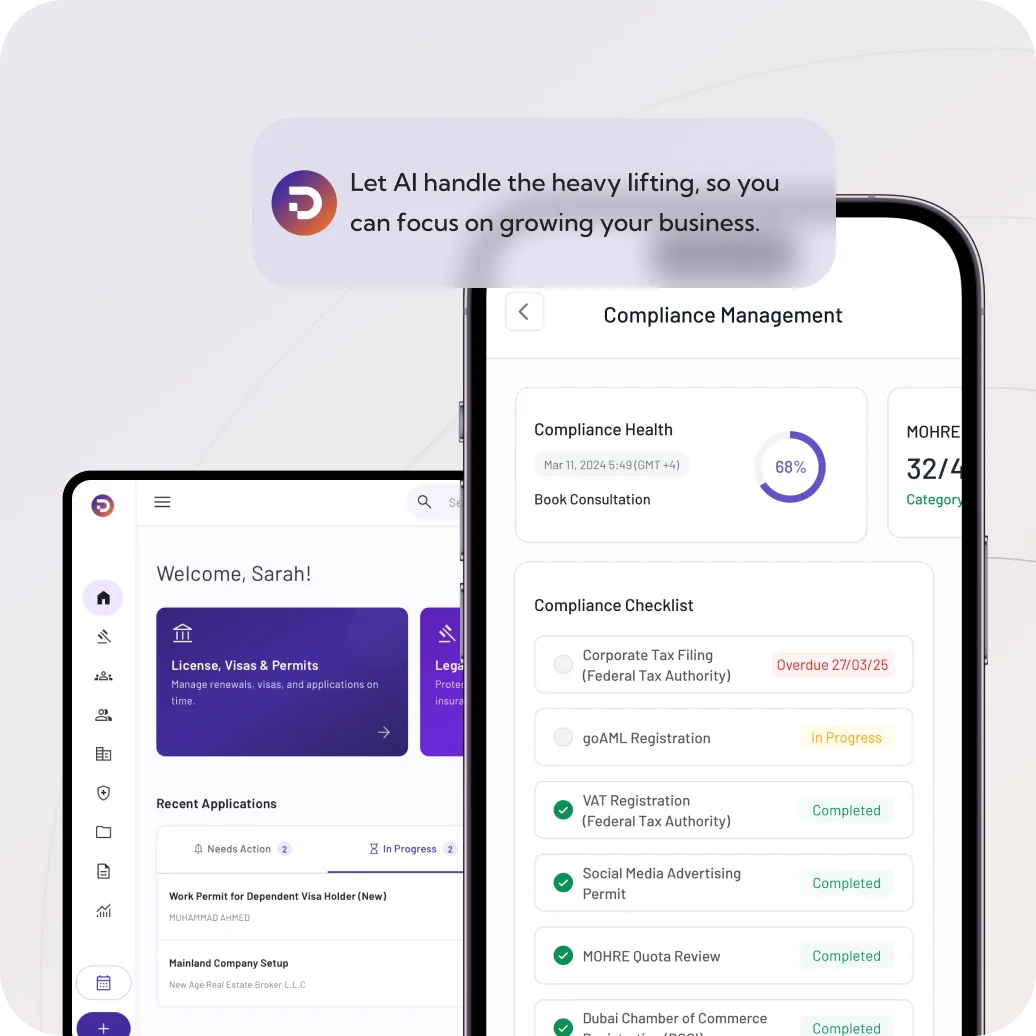
DocuBay is built to help businesses stay ahead of deadlines, document requirements, and compliance obligations without relying on manual reminders and scattered records. The platform brings tracking, verification, alerts, and reporting into one place so teams can operate with more confidence and fewer avoidable gaps.
Smart Pre-Submission Checks
Digital KYC, KYB & AML Screening
Compliance Dashboard & Risk Visibility
Centralized Document Vault
Reminders, Expiry Tracking & Audit Trail

Expert support when it matters
Some workflows need more than software alone. DocuBay combines platform control with guided support, specialist coordination, and practical help across complex business processes in the UAE. That gives teams a clearer path when decisions, approvals, or higher-risk requirements need closer attention.
Guided Onboarding & Setup Support
Legal & Compliance Consultation
Dedicated Relationship Support
Knowledge Portal & Practical Resources
Priority Support, Training & Enablement
What Our Clients Say
 MatthiasCEO of TechnoGenius GMBHI was overwhelmed keeping track of licences, visas and contracts across different portals. DocuBay brought everything into one place and their team jumped in whenever I had questions.KAKhalidCEOAfter expanding to Abu Dhabi, managing permits felt impossible. DocuBay’s team guided me step by step, handled every form and kept me updated. I finally have a reliable partner and can focus on serving clients instead of chasing approvals.
 JayeshOperations ManagerOur HR team was drowning in visa renewals and labour approvals. DocuBay turned it around, submissions are a breeze and someone is always on hand to help. We’ve cut processing time in half and can finally focus on our people.
 RaniaGeneral ManagerOpening our cafe used to mean endless trips for food-safety and health permits. DocuBay handled every NOC, inspection and renewal, with clear updates along the way. It feels like having our own compliance team on call.
 AishaOperations DirectorWe needed to get new hires through residency and contracts fast, but paperwork was holding us back. With DocuBay, everything is submitted online and approvals arrive on time, onboarding is smooth again.
 RaviBusiness OwnerDeadlines used to sneak up on us and trigger fines. DocuBay’s reminders pop up exactly when we need them, and all our documents live in one place. Now we never miss a renewal, and the stress is gone.
 AnastasiaHR Manager of Gulf Gate HoldingsHiring across the UAE meant endless back-and-forth with government offices. DocuBay’s platform and team simplified every step, one upload, clear status updates and friendly support. It turned a painful process into a breeze.JAJaneMarketing MavenI was dreading the red tape when we launched in Dubai. DocuBay’s team explained everything in simple terms, handled our permits and legal docs, and kept us on track. It felt like having an expert advisor at my side.
- MKMalikManaging PartnerAs an expat, UAE regulations felt like a maze. DocuBay guided me through every step, company setup, visas, renewals, and answered all my questions. They made a daunting process feel effortless.
 AhmadFounder, Innovate SolutionsWe used to chase visa renewals and updates daily. With DocuBay, applications are submitted in minutes and approvals arrive on time. Their reliable service has become our go-to for all legal and compliance needs.
Managing Business Made Easy!
Let our specialists handle the paperwork, timelines, and risk analysis while you focus on growth.



* Prices and services are subject to change. ** Timeframes are estimates and may vary. For full details, please review our Terms of Service.