
Why DocuBay

Services

License & Compliance Management


Workforce & Employment

Permits & Approvals

Insurance & Risk Management

Legal Services

Audit, Tax & Accounting

Company Formation


SPV & Holding Company Setup
Compare SPV and holding company structures, evaluate the right jurisdiction, and manage post-incorporation compliance through one more structured platform experience.
When a business needs to hold assets, isolate risk, structure investments, or centralize ownership, the entity choice matters. An SPV and a holding company can serve very different purposes depending on what is being held, why the structure is being created, and what obligations will continue after incorporation. DocuBay helps founders, investors, CFOs, and business leaders bring more clarity to that decision while supporting the compliance, document, and oversight layer that follows after setup.




500+
Applications Processed/Month



25+
Skilled Team Experts



The right structure does more than hold assets — it shapes everything that follows
A structuring decision at the start affects far more than incorporation. It can shape ownership control, risk isolation, governance, future transactions, reporting expectations, and compliance responsibilities over time. For founders, investors, finance leaders, and senior decision-makers, the question is not only where to set up, but whether the structure itself is aligned to the purpose it is meant to serve.
SPV and holding company are often grouped together, but they are not always the same decision
Many businesses begin with a broad goal: hold an investment, ring-fence a liability, own shares in a subsidiary, protect intellectual property, or centralize strategic assets. The difficulty is that SPV and holding company are often used interchangeably, even when the purpose, governance model, and compliance expectations may differ. An SPV is often better suited to a narrower, purpose-specific use case such as isolating a defined asset, transaction, project, or risk. A holding company is often better suited to broader ownership and control across subsidiaries, long-term investments, or strategic assets. When the wrong structure is chosen too early, the issues may appear later: document complexity, governance confusion, provider fragmentation, filing gaps, and weak visibility over what must be maintained after incorporation. That is exactly where a compliance-led platform like DocuBay becomes relevant.

SPV or holding company: choose the structure that fits the purpose
The right structure depends on what needs to be owned, protected, financed, or separated.
SPV
A special purpose vehicle is typically used when the goal is to isolate a specific asset, liability, investment, project, transaction, or legal exposure within a dedicated entity. It is usually narrower in purpose and more focused in scope.
Common fit
- Ring-fencing a specific asset or liability
- Investment and financing structures
- Joint venture vehicles
- Transaction-specific ownership
- Structured asset-holding arrangements
Holding Company
A holding company is typically used for a broader ownership role. It can sit above subsidiaries, centralize shareholding, own strategic assets such as intellectual property or long-term investments, and support group-wide corporate structuring.
Common fit
- Holding shares in subsidiaries
- Group ownership and restructuring
- Intellectual property ownership
- Long-term strategic investments
- Family or portfolio structuring
The right answer depends on the underlying objective, not just the label.
Common use cases for SPV and holding company structures
The right structure depends on what the entity is meant to hold, protect, separate, or control.
Hold shares in subsidiaries
Create clearer ownership lines and centralize control across group entities.
Ring-fence a specific risk
Separate a project, asset, or liability into a dedicated structure.
Own intellectual property
Hold strategic IP outside the operating entity for better structuring control.
Manage investment holdings
Use a dedicated entity to hold long-term investments or portfolio interests.
Structure a joint venture
Create clearer ownership and governance boundaries for shared business interests.
Support family or succession planning
Use entity structuring to support long-term ownership continuity and asset planning.
Choose the jurisdiction that fits the structure
Once the objective is clear, the next decision is jurisdiction. The right jurisdiction is not only about location. It is about the legal framework, type of structure available, setup model, compliance expectations, and the level of oversight required after incorporation.
DIFC
Relevant where a Dubai-based financial-centre jurisdiction is being considered for structured holdings, SPV-led ownership, or asset protection within a strong legal framework.
ADGM
Often considered where users want a modern, flexible, digitally oriented financial-centre route for structured holdings, investment vehicles, and ring-fenced ownership arrangements.
Offshore and Other Routes
Some users may require an offshore or alternative holding route rather than a financial-centre SPV route. These paths can be relevant where the main goal is holding assets, shares, or ownership interests without the same setup context as a financial-centre structure.
The goal is not to force every user into the same route. The goal is to identify the structure and jurisdiction that best support ownership, governance, asset protection, and ongoing compliance.
From structuring decision to ongoing compliance visibility
DocuBay's role is not to treat structuring as a one-time setup event. It is to make the structure easier to manage after incorporation. Once an SPV or holding company is live, the operational challenge usually begins: keeping KYC records current, maintaining entity documents, staying ahead of deadlines, coordinating filings, and retaining visibility across parties and workflows.
Compliance Management
Track obligations, deadlines, and compliance actions through one centralized environment designed to reduce missed filings and fragmented follow-up.
KYC & Document Readiness
Keep stakeholder records, due-diligence materials, and entity documentation organized in one place.
Post-Incorporation Oversight
Formation is only the start. Ongoing document maintenance, provider coordination, and filing visibility are what keep the structure usable over time.
Platform-Led Control
Instead of allowing incorporation records, approvals, compliance tasks, and supporting documents to sit across separate email chains and portals, keep visibility centralized through DocuBay.


How to get started
From structuring clarity to post-incorporation compliance, coordinated through one platform.
- 1
Define the objective
Clarify what the structure is meant to achieve: holding shares, isolating liability, owning IP, creating an investment vehicle, structuring a joint venture, or managing long-term ownership.
- 2
Compare SPV vs holding company
Assess whether the requirement is narrow and purpose-specific, or broader and ownership-led.
- 3
Evaluate the jurisdiction
Review whether DIFC, ADGM, offshore, or another route best supports the intended structure.
- 4
Coordinate setup and readiness
Prepare documents, complete KYC requirements, and organize entity information in a structured workflow.
- 5
Manage compliance after incorporation
Once the entity is live, continue tracking deadlines, records, filings, and related obligations through DocuBay's compliance layer.
Formation is only the first step. Compliance is what keeps the structure effective
A well-chosen structure can still become burdensome if the compliance side is neglected. Entity documents, filings, due-diligence records, governance updates, and provider coordination all continue after incorporation. That is why setup alone is not enough. Ongoing visibility matters just as much.
DocuBay is positioned to support that ongoing layer by giving users a more controlled compliance environment where documents, obligations, alerts, and workflow status remain visible and manageable over time.
The DocuBay Advantage
DocuBay helps businesses navigate company formation with more clarity around jurisdiction, approvals, regulatory requirements, and launch readiness.

Jurisdiction Clarity
Understand the difference between mainland, free zone, offshore, branch, and holding company structures more clearly, so you can choose the setup that fits your business.

Approval Support
Handle trade name, initial approval, and related setup requirements through a more guided process that feels easier to manage.

Regulatory Readiness
Stay better prepared for the approvals, documentation, and compliance steps that support a smoother company setup journey.

Banking Readiness
Move from company setup to bank account readiness with a process that feels more connected and better organized.
Limited Time Offer
Choose Your Compliance Plan
Compliance Core
Essential compliance foundation
What's included:
 License, Visa & Permit Tracking
- Smart Document Vault
- Employee Onboarding & Records
- Renewal Reminders and Alerts
- Application and Task Tracking
- Legal Hub Access
- Automated Backups
- Onboarding & Account Setup
What's included:
- Everything in Core
- KYC and KYB Verification Support
- AML Screening and Monitoring
- Compliance Dashboard
- WPS & Payroll Management
- Fines and Penalty Tracking
- Emiratization Tracking Support
- Advanced Reporting and Insights
- Priority Support
Compliance Enterprise
Advanced compliance operations at scale
Built for high-volume, multi-entity, and enterprise compliance environments.
What's included:
- Includes Everything in Core & Pro
- Dedicated Relationship Manager
- Custom Workflows and Approvals
- 24/7 Priority SLA Support
- Unlimited Users & Workspaces
- On-Site Training & Enterprise Onboarding
- High-Volume KYC, KYB & AML Screening
Do you need ⎯
some help?
Choosing between an SPV and a holding company depends on your objectives, governance requirements, and long-term compliance needs. Let our team help you understand the options.

What is the difference between an SPV and a holding company?
An SPV is typically used for a more specific purpose, such as isolating a particular asset, liability, investment, or transaction. A holding company is typically used for broader ownership objectives, such as holding shares in subsidiaries, strategic assets, or long-term investments.
How do I know whether I need an SPV or a holding company?
The answer depends on the objective. If the aim is to isolate a defined asset or risk, an SPV may be more suitable. If the aim is broader ownership, group control, or long-term asset holding, a holding structure may be more suitable.
Which jurisdictions are commonly considered for these structures?
DIFC, ADGM, and offshore routes are commonly evaluated depending on the objective, legal framework, setup requirements, and ongoing compliance expectations.
Does DocuBay focus on setup or compliance?
For this service, the emphasis is on structuring clarity and post-incorporation compliance management. DocuBay's broader platform is built around compliance tasks, digital KYC, reminders, document organization, and centralized workflow visibility.
Can DocuBay help after the entity is incorporated?
Yes. DocuBay's platform is especially useful for ongoing task visibility, risk monitoring, reminders, document storage, and compliance management after key corporate actions are completed.
Is DocuBay an open vendor marketplace for SPV and holding company setup?
No. DocuBay is positioned around structured support, controlled coordination, and compliance-led management rather than as an open marketplace.
Why is post-incorporation compliance important for these structures?
Because the long-term value of the structure depends on maintaining it properly. Entity records, filings, governance updates, and due-diligence readiness all continue after incorporation.
What You Get with DocuBay

Built for How Your Business Runs
From licensing and permits to legal, tax and entity work, DocuBay brings the processes that usually live in different places into one clear system — with better visibility and stronger control.
Licensing, Permits & Government Services
Legal, Corporate & Document Services
Tax, Audit & Compliance Filings
Visa, Employment & Residency
Compliance and Risk, Under Control
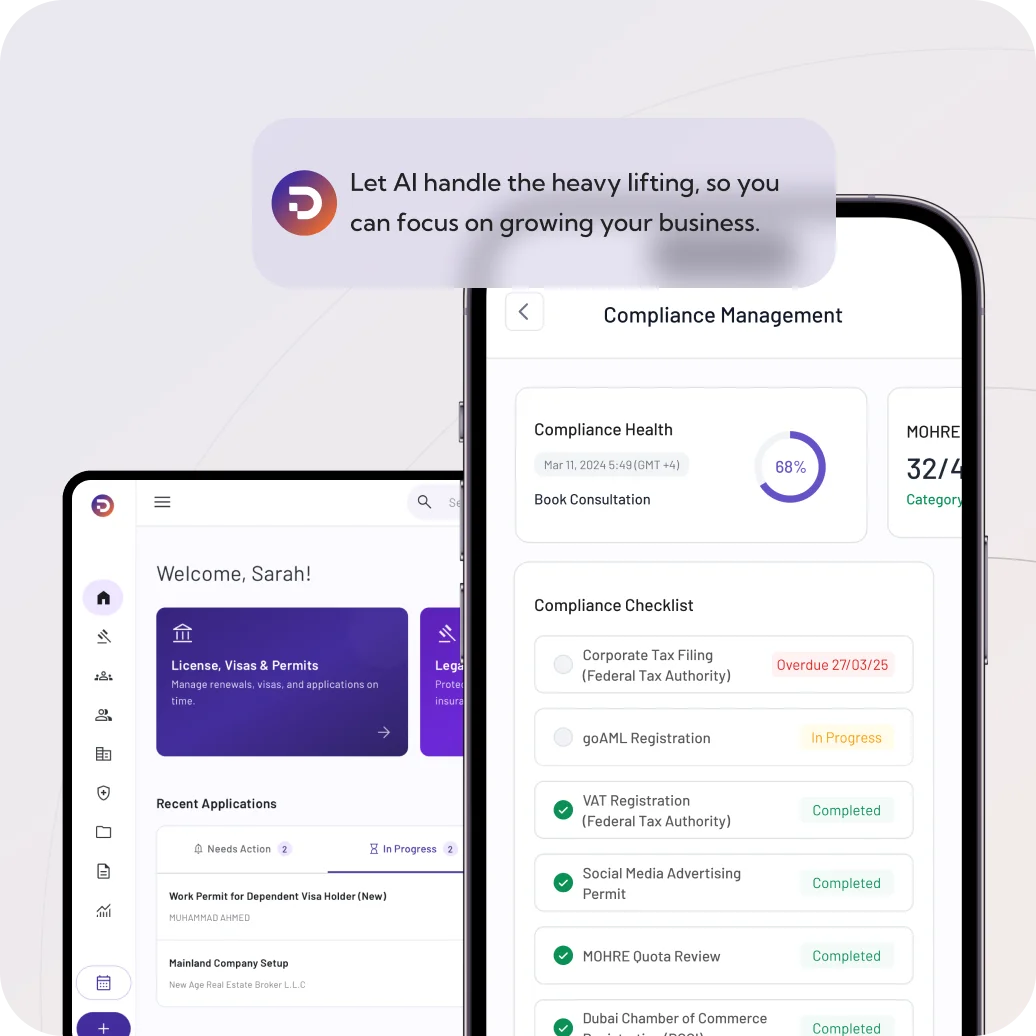
Stay ahead of every deadline and requirement without manual reminders or scattered records. DocuBay brings tracking, verification and alerts together — so your team operates with fewer gaps and more confidence.
Smart Pre-Submission Checks
Digital KYC, KYB & AML Screening
Compliance Dashboard & Risk Visibility
Reminders, Expiry Tracking & Audit Trail

Expert Support When It Matters
Some work needs more than software. DocuBay pairs the platform with guided help and specialist coordination across complex UAE processes — so you have a clear path when approvals or higher-risk requirements need attention.
Guided Onboarding & Setup
Legal & Compliance Consultation
Dedicated Relationship Support
Priority Support & Training
What Our Clients Say
 MatthiasCEO of TechnoGenius GMBHI was overwhelmed keeping track of licences, visas and contracts across different portals. DocuBay brought everything into one place and their team jumped in whenever I had questions.KAKhalidCEOAfter expanding to Abu Dhabi, managing permits felt impossible. DocuBay’s team guided me step by step, handled every form and kept me updated. I finally have a reliable partner and can focus on serving clients instead of chasing approvals.
 JayeshOperations ManagerOur HR team was drowning in visa renewals and labour approvals. DocuBay turned it around, submissions are a breeze and someone is always on hand to help. We’ve cut processing time in half and can finally focus on our people.
 RaniaGeneral ManagerOpening our cafe used to mean endless trips for food-safety and health permits. DocuBay handled every NOC, inspection and renewal, with clear updates along the way. It feels like having our own compliance team on call.
 AishaOperations DirectorWe needed to get new hires through residency and contracts fast, but paperwork was holding us back. With DocuBay, everything is submitted online and approvals arrive on time, onboarding is smooth again.
 RaviBusiness OwnerDeadlines used to sneak up on us and trigger fines. DocuBay’s reminders pop up exactly when we need them, and all our documents live in one place. Now we never miss a renewal, and the stress is gone.
 AnastasiaHR Manager of Gulf Gate HoldingsHiring across the UAE meant endless back-and-forth with government offices. DocuBay’s platform and team simplified every step, one upload, clear status updates and friendly support. It turned a painful process into a breeze.JAJaneMarketing MavenI was dreading the red tape when we launched in Dubai. DocuBay’s team explained everything in simple terms, handled our permits and legal docs, and kept us on track. It felt like having an expert advisor at my side.
- MKMalikManaging PartnerAs an expat, UAE regulations felt like a maze. DocuBay guided me through every step, company setup, visas, renewals, and answered all my questions. They made a daunting process feel effortless.
 AhmadFounder, Innovate SolutionsWe used to chase visa renewals and updates daily. With DocuBay, applications are submitted in minutes and approvals arrive on time. Their reliable service has become our go-to for all legal and compliance needs.
Compare the right structure before you commit
Whether the requirement is asset holding, ownership consolidation, risk ring-fencing, or investment structuring, the right route starts with a clear understanding of the structure and jurisdiction. Use DocuBay to bring more visibility, order, and compliance control to the process.



* Prices and services are subject to change. ** Timeframes are estimates and may vary. For full details, please review our Terms of Service.